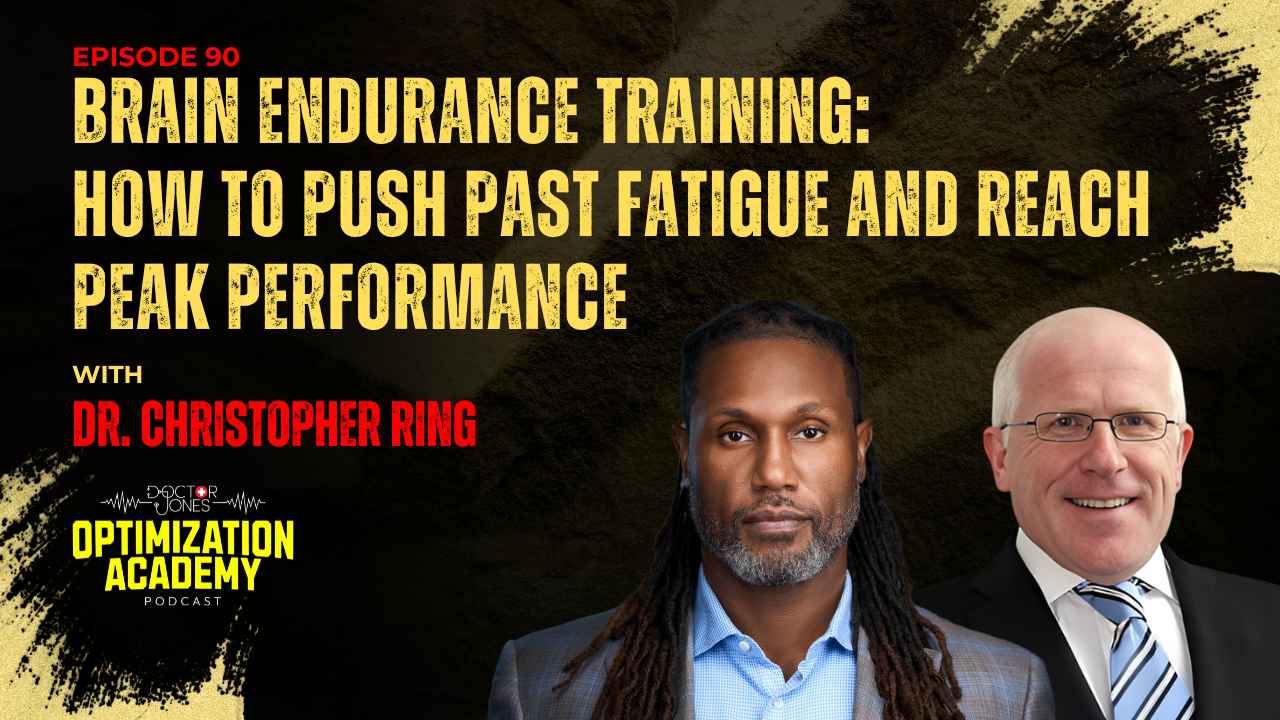
Brain Endurance Training and mental fatigue may be the missing link limiting your physical performance, and this episode reveals how your brain, not your body, could be the true bottleneck. In this high-impact conversation, Dr. Greg Jones sits down with Dr. Christopher Ring, Professor of Psychology at the University of Birmingham, to explore how cognitive load, stress, and perception of effort directly influence endurance, recovery, and overall performance.
In this episode, you’ll learn how mental fatigue can reduce physical output, why your brain acts as a “governor” on performance, and how Brain Endurance Training (BET) can help increase resilience, delay fatigue, and improve both cognitive and physical capacity. Dr. Ring explains the science behind perceived exertion (RPE), how stress impacts the nervous system, and why traditional training has overlooked one of the most critical components of performance.
We also explore how modern lifestyles—especially screen time and cognitive overload—may be silently reducing exercise capacity, and how targeted brain training protocols can reverse these effects. Whether you’re an elite athlete, a high-performing professional, or someone looking to improve focus and endurance, this episode provides a science-backed framework for building a more resilient brain and body.
If you’re looking to break through plateaus in performance, reduce fatigue, and train smarter, this episode offers a powerful and practical blueprint grounded in cutting-edge research.
📌 About Dr. Christopher Ring:
Christopher studied psychology at the University of Hull, graduating with a first-class degree in 1987. He then studied psychology at the State University of New York at Stony Brook under the supervision of Jasper Brener, completing his doctorate in cardiac psychophysics in 1993. This was followed by a post-doctoral fellowship in respiratory psychophysiology at Ohio University. In 1995, he joined the School of Sport, Exercise and Rehabilitation Sciences at the University of Birmingham.
🔗 Learn more about Dr. Christopher Ring: https://www.birmingham.ac.uk/staff/profiles/sportex/ring-christopher
📌 Connect with Dr. Greg Jones:
Instagram: https://www.instagram.com/doctorjones_doctorjones
Facebook: https://www.facebook.com/DrJonesNMD
Book Dr. Jones at your next event: https://www.drjonesnmd.com/
Enovative Wellness Center: https://enovativewellness.com/
📣 Subscribe + Follow:
YouTube: https://www.youtube.com/@DrGregJonesNMD
Spotify: https://open.spotify.com/show/2QrMGwCIGo1kjdezfCyYDK
🔗 Want to Learn More? Check these resources:
Mental fatigue impairs physical performance (foundational study): https://pubmed.ncbi.nlm.nih.gov/19131473/
Brain endurance training improves performance: https://pubmed.ncbi.nlm.nih.gov/36370703/
Stress physiology and systemic health: https://pubmed.ncbi.nlm.nih.gov/33218873/
American Physiological Society Journal: Mental fatigue impairs physical performance in humans
https://journals.physiology.org/doi/abs/10.1152/japplphysiol.91324.2008
🔬 Timestamps
Introduction to Brain vs Physical Performance (00:00 – 01:12)
The Stress Paradox and Immune Priming (01:12 – 02:09)
Acute vs Chronic Stress (02:09 – 05:02)
Heart Rate Awareness vs Performance (05:02 – 09:27)
Why Office Work Increases Fatigue (09:27 – 10:26)
Why Science Ignored the Brain (10:26 – 13:43)
The Brain as a Performance Governor (13:43 – 15:48)
RPE and Performance Limits (15:48 – 17:50)
Are Elite Athletes Protected? (17:50 – 22:37)
What is Brain Endurance Training (BET)? (22:37 – 25:34)
Measurable Brain Adaptations (25:34 – 28:35)
When to Apply BET (28:35 – 33:39)
BET for Busy Professionals (33:39 – 35:10)
Progressive Overload for the Brain (35:10 – 44:20)
BET vs Puzzles (44:20 – 48:45)
Clinical Applications (MCI, Diabetes) (48:45 – 54:18)
Reducing Mental Noise (54:18 – 56:33)
Adding Cognitive Load to Training (56:33 – 01:03:30)
Disclaimer: The information shared on The Dr. Jones Optimization Podcast and its associated YouTube channel is intended for educational and informational purposes only. It is not a substitute for professional medical advice, diagnosis, or treatment. Listening to this podcast or viewing its content does not create a doctor–patient relationship, and nothing shared should be interpreted as individualized medical guidance. Always consult with a qualified healthcare provider before making changes to your health regimen or managing a medical condition. The opinions expressed by Dr. Jones and his guests are their own and do not reflect official medical advice or recommendations